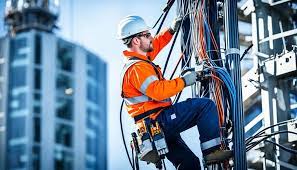
Fiber optic cables are an essential component of modern communication networks, enabling high-speed data transmission over long distances. These cables use light signals to transmit data, making them much faster than traditional copper cables. As our reliance on digital communication continues to grow, the importance of fiber optic cables in maintaining efficient and reliable networks cannot be understated.
With their ability to carry large amounts of data at incredible speeds, fiber optic cables have revolutionized the way we communicate and access information. From high-speed internet connections to secure telephone lines, fiber optic cables play a critical role in keeping us connected in today’s digital world. This article will explore the technology behind fiber optic cables, their advantages over traditional wiring methods, and the various applications that benefit from their use.

The Technology Behind Fiber Optic Cables
Fiber optic cables are made up of thin strands of glass or plastic that transmit data using light signals. These cables work on the principle of total internal reflection, where the light is bounced off the walls of the cable to carry data over long distances. The core of a fiber optic cable, where the light travels, is surrounded by a cladding layer that keeps the light contained within the core, ensuring minimal signal loss. The use of light signals instead of electrical signals allows fiber optic cables to transmit data at incredibly high speeds, making them ideal for applications that require fast and reliable communication networks. For a wide selection of fiber optic cables, check out fiber optic หลาย core for high-quality options.
Advantages and Applications of Fiber Optic Cables
One of the main advantages of fiber optic cables is their high bandwidth capacity, allowing them to carry large amounts of data over long distances without experiencing signal degradation. This makes fiber optic cables ideal for high-speed internet connections, telecommunication networks, and data centers where efficiency and reliability are crucial. In addition to their speed and bandwidth capabilities, fiber optic cables are also lightweight, immune to electromagnetic interference, and resistant to environmental factors like moisture and temperature changes. These qualities make them suitable for a wide range of applications, including telecommunications, cable television, and networking infrastructure. For a variety of fiber optic cables to suit your specific needs, visit fiber optic หลาย core for top-notch products.
In conclusion, fiber optic cables have significantly transformed the way we communicate and access information in the digital age. Their ability to transmit data at incredibly high speeds over long distances has made them an essential component of modern communication networks. With advantages such as high bandwidth capacity, immunity to electromagnetic interference, and resistance to environmental factors, fiber optic cables are utilized in various applications such as telecommunications, internet connections, and data centers. As our reliance on digital communication continues to grow, the importance of fiber optic cables in maintaining efficient and reliable networks cannot be overstated.
Leave a Reply